Our industry loves to sort creative work into two buckets. In one, “serious brand building” long-term, big budget TVCs, emotive storytelling, big platforms. In the other, “dumb fun” short-term stunts, social hacks, PR activations, playful ideas.
The assumption is that the dumb fun is disposable. But take a look at how people actually process information and marketing science tells a different story. Turns out dumb fun is doing a lot of the heavy lifting. Memory, salience, growth. All of it.
The thing that makes dumb smart is brand meaning. When a brand’s core meaning is tightly defined and consistently expressed, no idea is truly dumb, and if you know how to talk about it, your CFO will be its biggest advocate.
No one will argue with Byron Sharp’s rule that brands grow by being easy to think of and easy to buy. But getting into a buyer’s brain means breaking in, ideally at a moment linked to a category entry point, and then staying there. It’s the staying there that interests us, because that’s where dumb fun does its best work.
Les Binet and Peter Field found that fame campaigns, the ones people actively talk about, deliver the largest business effects of any campaign type. We think there are three reasons why.
They stay in the head longer. How long does a piece of wallpaper advertising survive in memory before it needs topping up? Compared with one piece of dumb fun, seared in on first exposure.
They give the business something to rally around. Internal teams, franchisees and retail partners get a story they actually want to tell.
The machines are starting to remember them too. This one is early and we hold it loosely. But dumb fun generates the thing large language models train themselves on: chatter, coverage, argument, repetition. The brands that get talked about are quickly becoming the brands that your LLM recommends.
The CFO conversation can’t be “trust us, it’s funny.” It needs to be a return on investment argument.
Rented memory versus owned memory. Paid recall starts to disappear the moment you stop paying for it, so the media budget becomes a subscription to being remembered. A fame idea that people repeat to each other keeps working long after the media is turned off.
Fame work isn’t instead of the brand campaign. It’s the thing that makes your brand campaign go further for the same money.
But again, none of this matters unless the idea is anchored in what the brand actually means.
Take State of Origin. It’s Tooheys’ biggest commercial trading period of the year, and the brand has a multi-decade commitment to the NSW Blues. Rather than buy ad space to claim that loyalty, we smuggled a giant wooden Trojan Stag (the stag from the logo) full of beer into enemy territory in Queensland.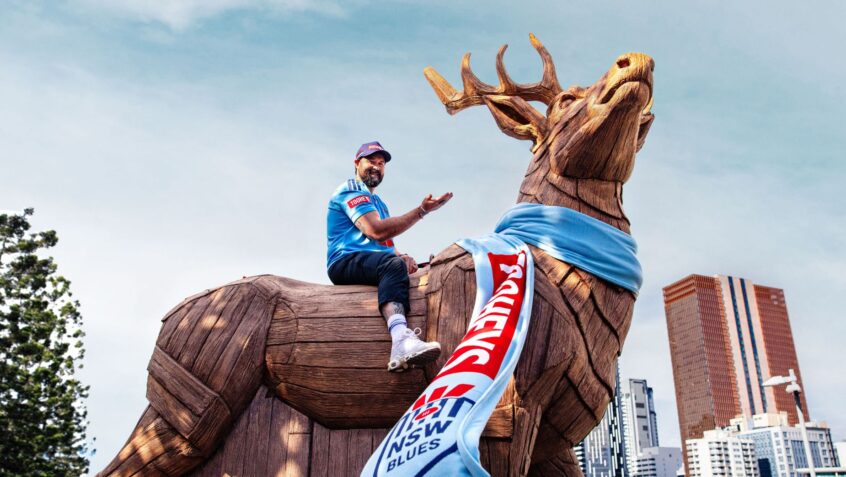
Dumb? On paper, yes. But the stag isn’t a prop we invented for a stunt. It’s the brand’s own icon, doing the brand’s own job. Tooheys stands for NSW loyalty, and Origin loyalty runs on cheeky, us versus them moments. The idea couldn’t have been done by anyone else, which is why it worked. It gave journos an instant visual hook, gave fans a rallying cry for their social feeds, and gave sales reps a story worth talking about.
For decades, a brand idea had to survive a chain of judgement before it ever reached the public. PRs pitched what they thought a journalist would take, journos pitched what they thought an editor would run, and the editor decided what the country got to read about that day. The media screened out the boring and commercial stuff and held the world to a consistent editorial standard.
Today the gatekeepers have stopped racing to be first. They hang back a little and wait for the community to decide what’s good, then report on the reaction. We call this Reverse Legitimacy.
Newsrooms are no longer guessing at what will meet their number one editorial priority of traffic, because they can now see the evidence in advance. An idea already generating chatter in a Reddit thread or piling up comments on Instagram is a pre-validated click driver. It’s shifted from “is this a good story?” to “is this already a conversation?”
So we’ve stopped pitching stories and waiting for a verdict. We pitch the proof of a conversation we’ve provoked. More often than not, those stories sit squarely in the dumb fun bucket.
Getting the coverage is the boring bit. What the coverage does next is the good bit.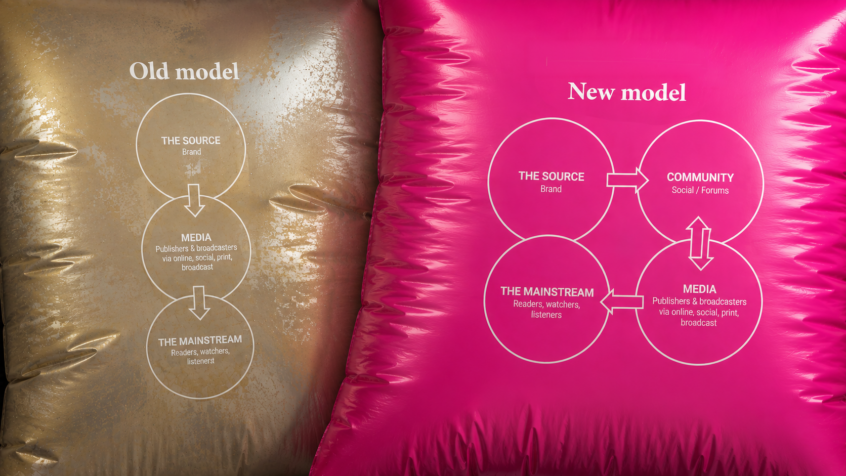
Under the old model, media was the finish line. You made something, the press ran it, everyone high-fived. Under Reverse Legitimacy, coverage is a bit more like a relay. The community makes the noise, the media reports the noise, and that news lands straight back in front of the community as fresh material as a new thing to screenshot, argue with, mock, or claim as their own. Which generates more noise, which can earn more coverage.
Dumb fun doesn’t have to be a spike, because it can be built to lap.
Take our recent work for BCF. The strategic undertow was simple, fishing sales go quiet over winter, and BCF needed to remind Aussies that the joy and ritual of fishing don’t have to stop when it gets cold. So we gave the national fishing shirt obsession an absurd winter upgrade: the BCF Fishing Winter Onesie.
We seeded the onesie inside the fishing community first. Teasers followed, including a moment on an NRL stadium big screen, then posts from The Betoota Advocate and Brown Cardigan. Reddit did what Reddit does, which gave us a real-time testing ground for the messaging and a bridge from subculture to mainstream.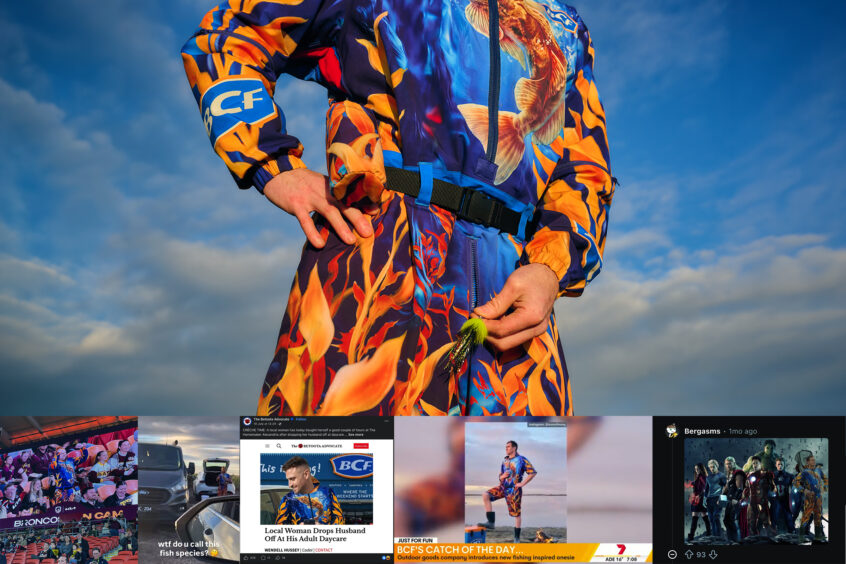
Only then did we reveal that Geelong forward Jeremy Cameron had been testing the onesie himself. Ten years ago, a name like Cameron’s was the story, it isn’t any more, it’s more like fuel. What the reveal did was hand an already live conversation another reason to keep going, which is what got us a breakfast TV segment focused on the crowd reaction rather than the product.
And then the coverage did its second job. The breakfast TV segment wasn’t the end of the chatter, it was the material for the next lap. Memes, debates and Fishtok content ran for weeks, and by the time journos were writing about it again, they were quoting the community back to itself. Over 30,000 organic shares of owned social content was the evidence they needed that the story was legitimate and worth the click.
None of which was a happy accident. If you plan for a single hit, you get a single hit. If you plan for the loop, you get…. A loop.
If these kinds of ideas were powerful a decade ago, they are mandatory now. Nobody’s ever dropped a functional ad into the group chat. They drop the stuff that made them laugh or made them go “what the fuck?”. But communities only adopt and share these moments when the joke makes sense for the brand delivering it. When brand meaning is consistent, dumb ideas can hand media a story with proven talkability.
Cheap is not the point. The point is people actually pass this stuff around, and they hang onto it.