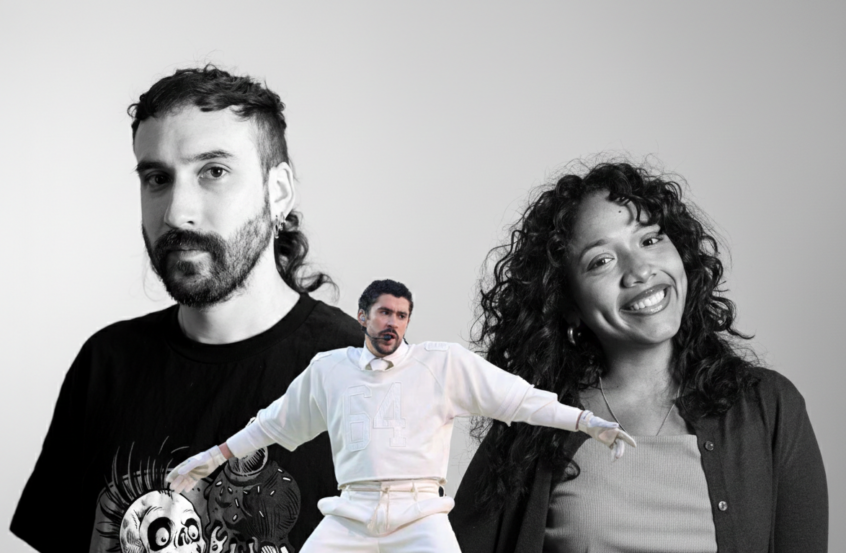
Bad Bunny’s Super Bowl halftime show wasn’t just a performance; it was a cultural lightning bolt. While some viewers reached for the remote in a huff, millions more leaned in, finding a rare moment of unity, belonging, and high-octane dance.
When the Grammy-winning Latin powerhouse, casually known as ‘Benito’, was first announced as the headliner, the “controversy” started brewing immediately. Benito isn’t one to play it safe; he’s carved out a spot as one of his generation’s most vocal artists, turning mainstream earworms into a megaphone for immigration, racism, and cultural identity.
Eduarda ‘E’ Cuadros, Media Thinker, and Alvaro Bretel, Exec Head Brand Thinker two of our Peruvian finest, peeled back the layers on how this performance landed (or didn’t) with global and Aussie audiences.
Cuadros said. “We’re falling into a relativistic world, where nobody can be too proud of where they come from, just so they are politically correct to everyone. That moment was saying you can be confident in being culturally specific.”
On the global stage, the “Benito Bounce” was very real for brands. Take Zara, for example. By dressing him for the show, the Spanish retailer banked US $3.1 million (AUD $4.3 million) in media brand value in just 12 hours.
But back in Australia? The vibe was a bit flatter. Between the massive geographic distance and the fact that the NFL isn’t exactly our “national religion,” the appetite just wasn’t there. With Latin Americans making up only between 0.5% and 1.1% of the Australian population, the cultural weight of the performance didn’t quite hit home. Without a massive local community to fuel the fire, the spectacle mostly glazed over Aussies who’d rather tune into homegrown events.
“It’s not on Australians for not having the exposure to it, or not having the curiosity for it. It’s just that it’s a bit too far geographically,” Bretel said.
This local “crickets” response highlights a broader hesitation in Australian media. There’s a gap when it comes to leaning into unapologetic cultural narratives that actually resonate with younger, more globalised audiences.
“Culture moves faster than brands and Bad Bunny’s culture is a big part of his brand,” Cuadros said. “Mainstream [Australian] media just hasn’t caught up to how culturally fluent people under the age of 35 are, there is a big lack of representation.”
The old-school rulebook said that to “make it” globally, Latin artists had to swap Spanish for English—the path trodden by Shakira and Ricky Martin in the 90s.
“In the past, every Latino artist that wanted global fame had to start singing in English, in a language that more people would understand even though there are 1 billion Spanish speaking people in the world,” Bretel said.
Benito has officially ripped up that rulebook. As the first non-English singer to snag a Grammy for Album of the Year, he’s proved you don’t have to water down your roots to dominate the charts.
“Culturally there is a lot of things he’s done to make political statements mainstream, and easy for people to digest and celebrate,” Bretel said. “When he gets on to the light poles, that’s a protest again. When Puerto Rico was suffering a lot of blackouts. Adding the sugar cane, that ties back to Spanish colonialism.”
Ultimately, the performance was a masterclass in how bold, inclusive narratives can bridge communities—even if Australia is only just starting to feel the ripple.
“The beauty of that Super Bowl halftime show was that he was saying, No, don’t hide. Show all of your colours, show exactly who you are and be proud of it,” Cuadros said.